Jeonju is known for its large hanok (traditional house) village and for being named Korea’s first UNESCO Creative City of Gastronomy, per VisitKorea. This guide covers ten sights in the old centre and just south of it, how to reach Jeonju from Seoul, and the hours and admission the official pages state.
The places below are ones that the Korea Tourism Organization (VisitKorea) and the Jeonju Hanok Village office describe, plus sites that those pages list with an official heritage designation. The order follows a walk through the old centre, then two places further out. It is not a ranking.
Getting there and around
Jeonju is in Jeollabuk-do (Jeonbuk), in the south-west. The Hanok Village office says trains run between Seoul’s Yongsan Station and Jeonju Station, including KTX, Saemaeul and Mugunghwa services. VisitKorea gives the following travel times (its page was last updated in July 2025 and says to check current schedules):
| From | To | Time per VisitKorea |
|---|---|---|
| Seoul Yongsan Station (KTX) | Jeonju Station | About 1 hr 40 min |
| Seoul Central City Terminal (express bus) | Jeonju Express Bus Terminal | About 2 hr 40 min |
| Incheon Airport (limousine bus) | Jeonju Express Bus Terminal | About 3 hr 10 min |
For booking, see KTX Booking with a Foreign Card and Intercity Express Buses. For the airport leg, see Incheon Airport to Seoul.
From the stations to Hanok Village, the Hanok Village website lists these options (checked 2 Nov 2026):
- From Jeonju Station: city bus from the Jeonju Station stop to the Jeondong Cathedral (Hanok Village) stop, about 25 minutes. Routes listed: 112, 79, 508, 536, 542, 545, 546, 101, 119 and 999. Estimated taxi fare: ₩7,000 to ₩8,000.
- From the Express Bus Terminal: bus 79, 999 or 1994 from the Bulgyo Hall (불교회관) stop to the same Jeondong Cathedral stop, about 15 minutes. Estimated taxi fare: ₩5,000 to ₩6,000.
The sights in the old centre are close together, and VisitKorea describes the Hanok Village as best explored on foot. Taxi fares are estimates from the village site, not fixed prices. For taxi apps without a Korean number, see Taxis Without a Korean Number. For paying for local transport, see T-money with a Foreign Card, and for maps and bookings, Naver Map for Visitors.
The Hanok Village Tourist Information Center is at 99 Girin-daero. Its English page says it is open 24 hours, every day, and gives the phone number 063-282-1330. The national 1330 Korea Travel Helpline is also named by VisitKorea for current opening hours and fees.
For maps, translation and transport apps that work in Korea, see our apps for Korea guide.
Major sights
Jeonju Hanok Village (전주한옥마을 Jeonju Hanok Maeul)
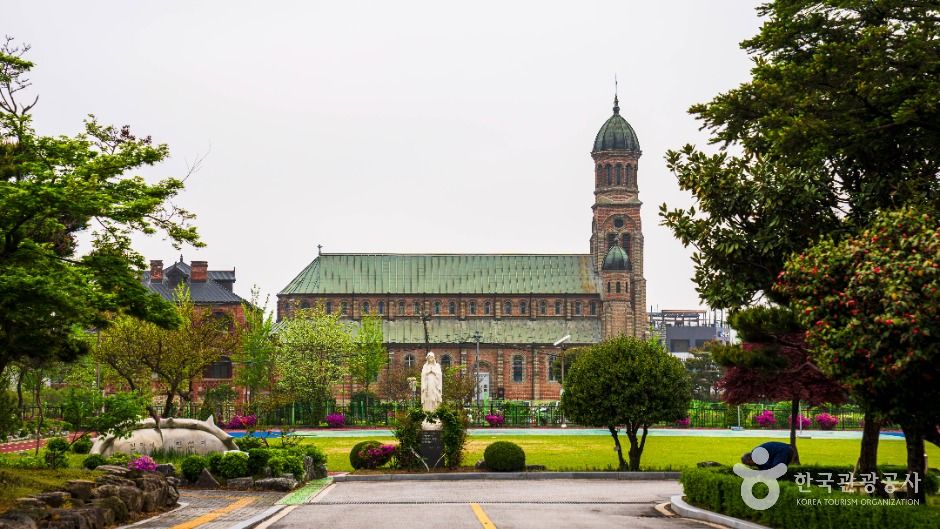
VisitKorea describes this as Korea’s largest traditional hanok village, with around 700 houses, and the only one of its kind in a city. It grew from the early 1900s around Gyeonggijeon Shrine, Omokdae and the Jeonjuhyanggyo school, and its title carries the Slow City label. Visitors walk the lanes, join crafts, traditional games, performances or hanbok (traditional dress) activities, or stay in a hanok. The Hanok Life Experience Hall is the place VisitKorea suggests for a look at hanok living.
- Getting there: see the bus options above; the stop is named after Jeondong Cathedral.
- Hours, closed days, admission: open all year and free to walk, per VisitKorea, checked 2 Nov 2026. Individual attractions and experiences set their own hours and prices.
- Official page · Map
Omokdae and Imokdae (오목대·이목대 Omokdae, Imokdae)
These two hillside sites are tied to Yi Seong-gye, who later became King Taejo, founder of the Joseon dynasty. Omokdae is a hilltop spot linked to his victory over Japanese raiders. Across a bridge, Imokdae is linked to his ancestors, with memorial stones carrying the handwriting of Emperor Gojong, according to the Korea Tourism Organization record. The Hanok Village site lists the pair as Jeollabuk-do Monument No. 16.
- Getting there: Check the official page for directions.
- Hours, closed days, admission: Check the official page for hours and admission.
- Official page · Map
Jeonjuhyanggyo Confucian School (전주향교 Jeonju Hyanggyo)
A local Confucian school from the Joseon period that was moved to its present site in 1603, per the Korea Tourism Organization record. The Hanok Village site lists it as Historical Site No. 379 and says the main shrine holds tablets honouring Confucian sages. The same record notes a ginkgo tree of about 400 years in the front yard, which it describes as at its best in autumn.
- Getting there: Check the official page for directions.
- Hours, closed days, admission: 10:00 to 18:00 and free, per the Hanok Village site, checked 2 Nov 2026. Closed days are not stated there.
- Official page · Map
Jaman Mural Village (자만마을 벽화갤러리 Jaman Maeul Byeokhwa Gaelleori)
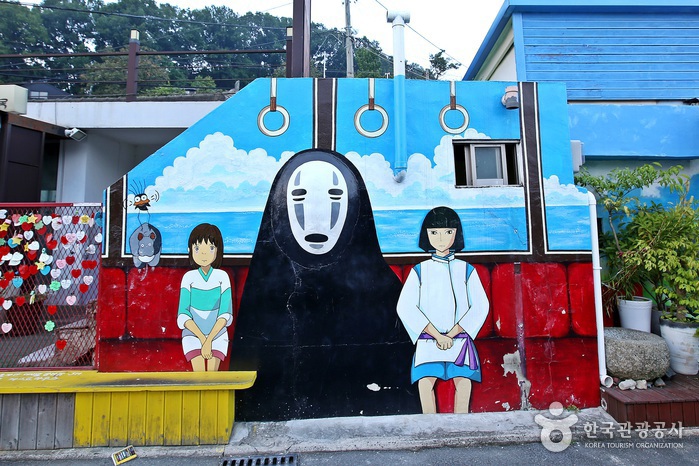
A hillside neighbourhood across the road from Hanok Village. It began as a settlement of Korean War refugees, and a city project added more than 40 murals in 2012. VisitKorea says many of the houses are now cafes, guesthouses or restaurants.
- Getting there: Check the official page for directions. VisitKorea lists no parking here.
- Hours, closed days, admission: open 24 hours, no closed days, and no admission fee listed, per VisitKorea, checked 2 Nov 2026.
- Official page · Map
Gyeonggijeon Shrine (경기전 Gyeonggijeon)
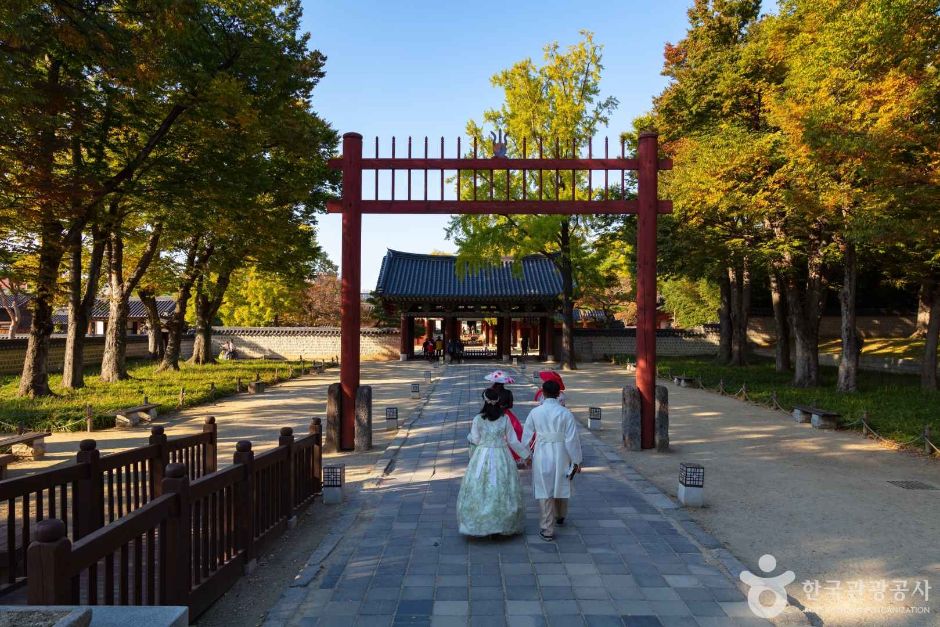
A shrine founded in 1410 that holds a portrait of King Taejo, the first Joseon king. It was damaged in the Imjin War and restored in 1614, and the Hanok Village site lists it as Historical Site No. 339. The grounds include a bamboo grove and stone walls, and it is often used as a filming location for period dramas.
- Getting there: inside Hanok Village, at 44 Taejo-ro.
- Hours, closed days, admission: 10:00 to 18:00, open all year, per the Hanok Village site, checked 2 Nov 2026. For people who do not live in Jeonju, tickets are listed at ₩3,000 (adults), ₩2,000 (youth students) and ₩1,000 (children); check the page for the age bands. Admission is free on Culture Day, the last Wednesday of each month.
- Official page · Map
Jeondong Catholic Cathedral (전주전동성당 Jeonju Jeondong Seongdang)
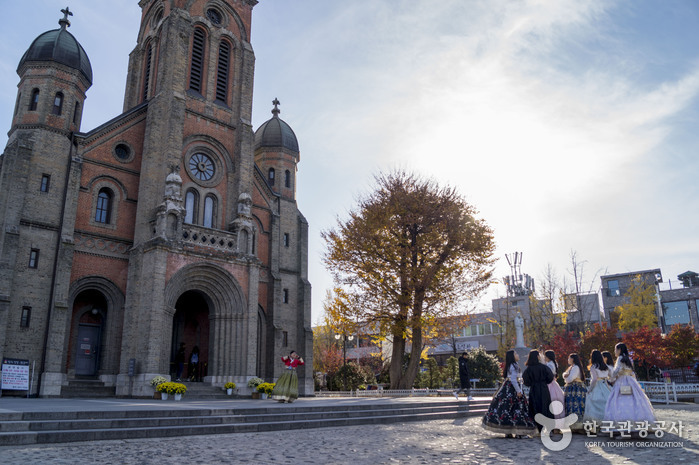
A brick church built on the site where Catholic martyrs of the Joseon period were executed. It was completed in 1914. VisitKorea describes a blend of Byzantine and Romanesque styles with three bell towers and stained glass, and the Hanok Village site lists it as Historical Site No. 288.
- Getting there: at 51 Taejo-ro; the main bus stop for Hanok Village is named after it.
- Hours, closed days, admission: 09:00 to 17:00 except during mass times, and free, per the Hanok Village site, checked 2 Nov 2026. Closed days are not stated.
- Official page · Map
Pungnammun Gate (풍남문 Pungnammun)
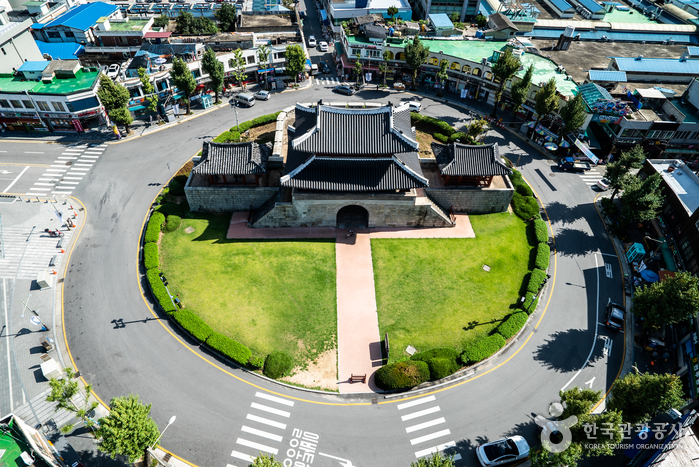
The south gate of the old Jeonju city wall, a designated Treasure (No. 308 per the Hanok Village site). It stands between Hanok Village and Nambu Market. The two official pages give different construction dates, so this guide does not state one.
- Getting there: at 1 Pungnammun 3-gil. VisitKorea lists no parking.
- Hours, closed days, admission: open all year with no hours listed, per VisitKorea, checked 2 Nov 2026. Check the official page for admission.
- Official page · Map
Jeonju Nambu Market (전주 남부시장 Jeonju Nambu Sijang)
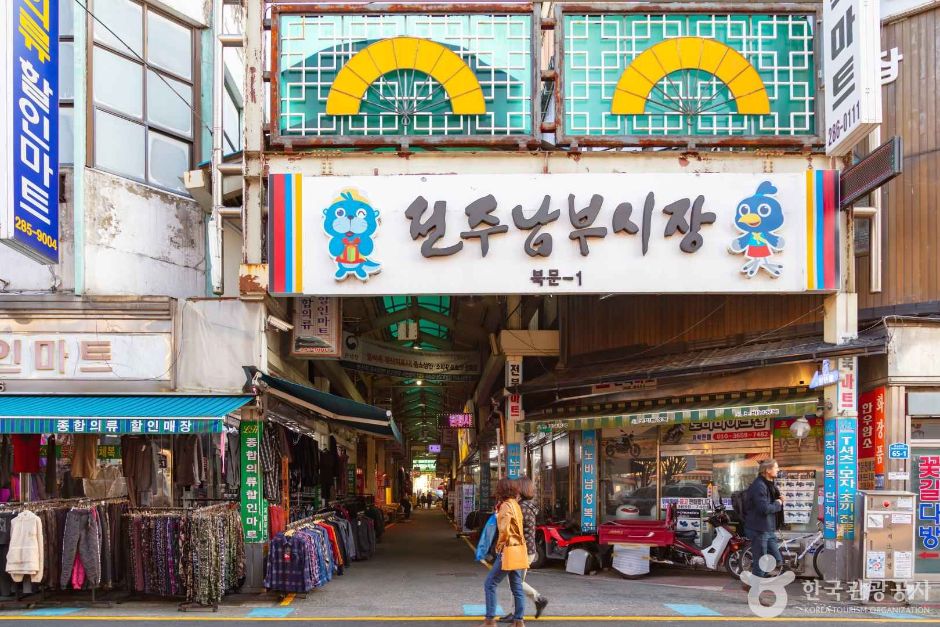
A market that became a regular public market in 1905, with about 800 shops selling fabrics, furniture, dried seafood, produce and medicinal herbs. Young people have opened a youth mall on the second floor of Building 6. A night market runs every Friday and Saturday, with snacks such as blood sausage meals, mung bean pancakes and bibimbap rolls, per VisitKorea.
- Getting there: at 19-3 Pungnammun 1-gil, near the gate above.
- Hours, closed days, admission: 09:30 to 23:00, though hours vary by shop, per VisitKorea, checked 2 Nov 2026. No market-wide closed day is listed. Night market times are not listed. Cards are accepted, per the same page.
- Official page · Map
Wansan Park (완산공원 Wansan Gongwon)
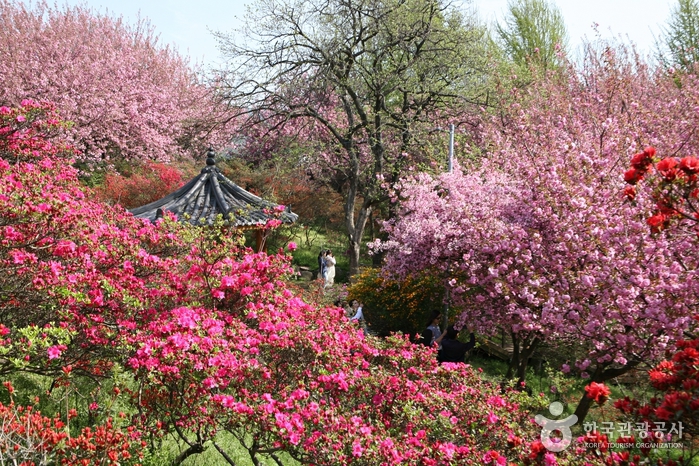
A hilltop park on the southern edge of central Jeonju, also called Wansanchilbong Peak. It has Chilseongsa Temple and a pavilion at the top with views over the area, and it was the site of fighting in the Donghak Peasant Revolution. VisitKorea’s city overview also mentions more than 1,500 flowering trees.
- Getting there: at 19-4 Gongsunae 1-gil; parking is available. Check the official page for transit directions.
- Hours, closed days, admission: free, per VisitKorea, checked 2 Nov 2026. Hours and closed days are not listed.
- Official page · Map
Jeonju National Museum (국립전주박물관 Gungnip Jeonju Bangmulgwan)
A national museum opened in 1990 that holds more than 40,000 artefacts, most of them excavated in Jeollabuk-do. More than 2,000 pieces are on show across four indoor halls and one outdoor area. There is also a children’s museum with its own reservations.
- Getting there: 249 Ssukgogae-ro, outside the old centre. The museum lists city buses 7-1, 12, 19, 49, 62, 131, 554, 559, 644 and 684 for the “Family Land / Geumgu” direction, and taxi times of about 30 minutes from Jeonju Station or 20 minutes from the Express Bus Terminal.
- Hours, closed days, admission: permanent exhibitions 10:00 to 18:00, last entry 17:30; closed on 1 January, Seollal and Chuseok; free, though special exhibitions may charge, per VisitKorea, checked 2 Nov 2026.
- Official page · Map
Practical notes
- Guided walks: the 2026 English Hanok Village map lists a Gyeonggijeon history tour at 11:00 and 14:00 (Korean, English, Chinese, Japanese) and an alley tour at 11:00 (Korean, English) and 15:00 (Korean, English, Chinese, Japanese). Confirm the schedule with the information center.
- Free-entry days: Gyeonggijeon is free on Culture Day, the last Wednesday of each month.
- Night market: Nambu Market’s night market runs Friday and Saturday only, so plan the market for one of those evenings.
- Seasons and festivals: VisitKorea lists the Jeonju International Film Festival in spring and the Bibimbap Festival in October, but its dates were for 2025. Check the current year’s dates before booking. For clothing by season, see Korea Weather by Season.
- Holidays: some sites close on Seollal and Chuseok. See Korean Public Holidays 2026-2027.
Related guides
- Gyeongju Travel Guide: Major Sights and Access
- Seoul Travel Guide: Major Sights and Access
- KTX Booking with a Foreign Card
Sources
- Jeonju Hanok Village — Heritage sites (English), checked 2 Nov 2026
- Jeonju Hanok Village — English map 2026, checked 2 Nov 2026
- Jeonju Hanok Village — Directions, checked 2 Nov 2026
- VisitKorea — Jeonju, a Slow City of Hanok and Serenity, checked 2 Nov 2026
- VisitKorea — Jeonju Hanok Village [Slow City], checked 2 Nov 2026
- VisitKorea — Jeonju Nambu Market, checked 2 Nov 2026
- VisitKorea — Jeonju Pungnammun Gate, checked 2 Nov 2026
- VisitKorea — Jaman Mural Village, checked 2 Nov 2026
- VisitKorea — Wansan Park, checked 2 Nov 2026
- VisitKorea — Jeondong Catholic Church, checked 2 Nov 2026
- VisitKorea — Jeonju National Museum, checked 2 Nov 2026
- Jeonju National Museum — English site and location page, checked 2 Nov 2026
- VisitKorea — Time-honored Beauty, Jeonju Hanok Village, checked 2 Nov 2026
- Korea Tourism Organization place records (Tour API) for the sights above, checked 2 Nov 2026