Gangwon is the mountain and east-coast province east of Seoul. This guide covers ten places, ordered from Chuncheon in the west to Sokcho in the north-east, and how to reach them by rail, bus and local transport.
The selection is based on places featured by Korea Tourism Organization (KTO) and the Gangneung city tourism portal, plus sites with an official designation such as national park, UNESCO biosphere reserve or national Treasure. It is a route-ordered list, not a ranking.
Getting there and around
Gangwon is large, and the places below sit in separate clusters. Pick one or two clusters per trip rather than trying to cover the whole province.
- Gangneung by train. Gangneung is on the KTX Gangneung Line. The English page of Gangneung city (undated, and it refers to the line opening in December 2017) gives about 2 hours from Seoul Station and about 1.5 hours from Cheongnyangni Station. Its timetable and fares look old, so check Korail for current trains.
- Korail ticket rules. Per Korail’s English site, checked 2 Nov 2026, tickets go on sale from 07:00 one month before departure and can be bought online until 20 minutes before the train leaves. A Korail Pass covers KTX-Eum. The same site lists a notice dated 21 Aug 2026 titled “Temporary Unavailable Foreign Credit Card Services”, but its body text did not display when checked. See KTX Booking with a Foreign Card before you plan to pay by card.
- Gangneung by bus. Per Gangneung city’s English page, express buses to Gangneung leave Seoul from the Express Bus Terminal (subway lines 3, 7, 9) and the Dong Seoul Terminal (line 2, Gangbyeon). The page also lists airport buses from Incheon and Gimpo that it says take 3 to 3.5 hours. See Intercity Express Buses: Booking and Terminals.
- Chuncheon and Nami Island. KTO describes Chuncheon as the only city in Gangwon-do that can be reached from Seoul by subway. Nami Island’s own site gives routes via Gapyeong Station on the Gyeongchun subway line or ITX-Cheongchun (details under Nami Island below).
- Seoraksan. The park’s directions page lists driving routes only, so check Korail, Kobus and local bus operators for public transport to Sokcho and Yangyang.
- Getting around locally. See T-money with a Foreign Card, Taxis Without a Korean Number, Naver Map for Visitors and Apps for Korea. If you plan to drive, read Driving in Korea with a Foreign Licence.
Major sights
Nami Island (남이섬)

Nami Island is a river island known for its gardens and forest, plus exhibitions, concerts and events. KTO’s list “100 Must-Visit Tourist Spots of Korea” includes it. Administratively it is part of Chuncheon, but the ferry pier is in Gapyeong, Gyeonggi-do, and the crossing takes about 5 minutes, per the island’s official site.
- Getting there: per Nami Island’s site, take the Gyeongchun subway line or ITX-Cheongchun to Gapyeong Station. The station is about 1.5 km from the pier: roughly 20 minutes on foot, or about 5 minutes by city bus 10-4 or taxi. The site also lists a direct shuttle from Seoul run by a designated company, Ktourstory.
- Hours, closed days, admission: per Nami Island’s site, checked 2 Nov 2026, the first boat to the island leaves at 08:00 and the last at 21:00, with the last boat back at 21:05. From 18 Sep to 22 Nov 2026 the first boat is 07:30 daily. Entry includes the return ferry: adult ₩19,000 on the standard ferry, or ₩29,000 with a motorboat on the way in. Reduced fares apply to groups such as middle and high school students and people aged 70 and over. The site says operating times can change.
- Official page · Map
Soyanggang Skywalk (소양강스카이워크)

A walkway over the Soyang River in Chuncheon, 174 m long, with a transparent glass floor over 156 m of it, per the KTO record. At the end is a circular plaza and viewing area that the record singles out for sunset views, and a sculpture of a leopard mandarin fish.
- Getting there: Check the official page for transport.
- Hours, closed days, admission: Check the official page for hours and admission.
- Chuncheon tourism portal · Map
Woljeongsa and Odaesan National Park (월정사·오대산국립공원)
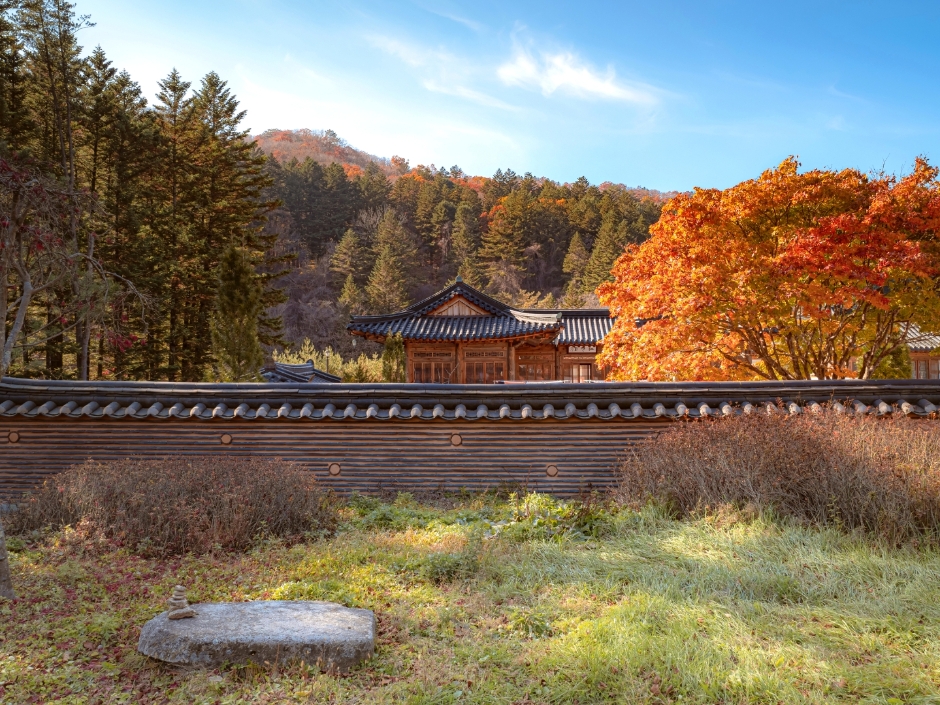
Woljeongsa is a temple on Odaesan, founded in 643 in the Silla period according to KTO. It has an octagonal nine-story stone pagoda from the Goryeo era, and a path of about 1 km lined with more than 1,700 fir trees runs from the Iljumun Gate to Geumganggyo Bridge. The temple surroundings are inside Odaesan National Park, which the Korea National Park Service says was named Korea’s 11th national park in 1975 and covers 327.904 km². The temple offers a Templestay (see Templestay in Korea).
- Getting there: Check the official page for transport.
- Hours, closed days, admission: Check the official page for hours and admission. The park office publishes live parking status for the Woljeong area; one notice dated 25 Oct 2026 reported the Woljeongsa car park full at 10:15, so arrive early on busy autumn days.
- Temple page · National park page (Korean) · Map
Ojukheon (오죽헌)
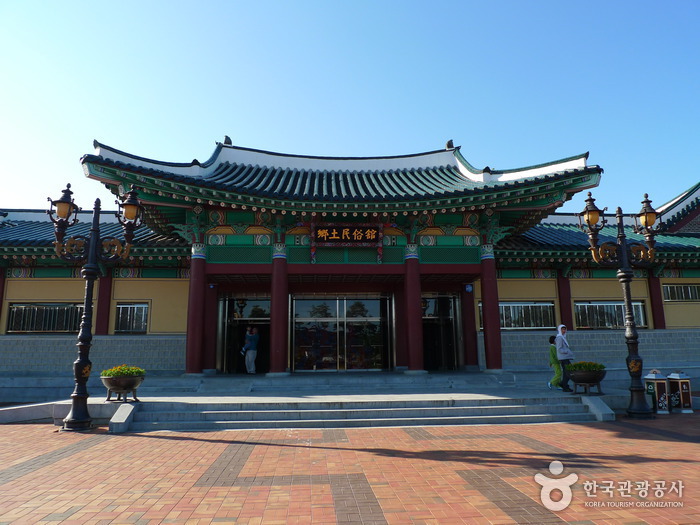
Ojukheon is the house in Gangneung where the scholar Yulgok Yi I was born. Gangneung city says it is a national Treasure (No. 165), and KTO calls it one of the oldest preserved Korean houses. The compound also has a shrine, a memorial hall and a municipal museum. The name comes from the dark bamboo (ojuk) growing behind the house.
- Getting there: Gangneung’s portal says city buses run frequently to Ojukheon; it does not name a stop. Check the official page.
- Hours, closed days, admission: per the Gangneung tourism portal, checked 2 Nov 2026: tickets sold 09:00 to 17:00, visiting 09:00 to 18:00, closed on 1 Jan, Seollal and Chuseok. Adult admission is listed as a range of ₩2,000 to ₩3,000 (youth ₩1,500 to ₩2,000, child ₩500 to ₩1,000, free for age 65 and over). The page does not explain what sets the price within each range, so check the current fare at the gate.
- Official page (Korean) · Map
Gyeongpodae Pavilion (경포대)
A pavilion on a small hill north of Gyeongpo Lake in Gangneung. Per KTO it was first built in 1326 and moved to its present site in 1508, and it is counted among the Eight Scenic Sites of Gwandong (the north-eastern coast). Gangneung city lists it as Treasure No. 2046. The interior carries calligraphy and poems by Joseon-era scholars, and the raised site looks over the lake and the sea.
- Getting there: Check the official page for transport.
- Hours, closed days, admission: per the Gangneung tourism portal, checked 2 Nov 2026: open all year, usable at any time, free, free parking.
- Official page (Korean) · Map
Gyeongpo Beach (경포해변)
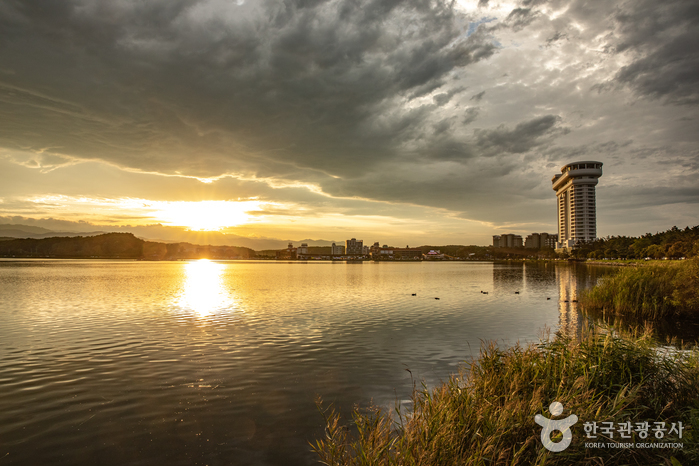
A sand bar between Gyeongpo Lake and the East Sea, 1.8 km long, with a pine forest behind it, per KTO. Gangneung city describes it as the largest beach on the east coast and notes that people gather here for the sunrise on 1 January, so book lodging early for that date. Swimming is a summer activity; the lake path and nearby pavilion suit other seasons.
- Getting there: Check the official page for transport. The city portal says the beach is about 15 minutes from central Gangneung.
- Hours, closed days, admission: per the Gangneung tourism portal, checked 2 Nov 2026: open at all times, no closed days listed, free parking. A shower is listed at ₩3,000 during the summer swimming season.
- Official page (Korean) · Map
Jeongdongjin Beach (정동진해변)
A beach in Gangneung where the railway station sits right by the sea; Gangneung city and KTO both note it is regarded as one of the world’s stations closest to the ocean. It is known for sunrise watching, and KTO says the Jeongdongjin Sunrise Tourist Train has run since 1997. The city page adds that the beach has a Sandglass Park, a sculpture park and a coastal terrace designated Natural Monument No. 437.
- Getting there: the city page says trains run between Seoul and Jeongdongjin; check Korail for the current service.
- Hours, closed days, admission: per the Gangneung tourism portal, checked 2 Nov 2026: open all year, usable at any time, free, free parking.
- Official page (Korean) · Map
Naksansa Temple (낙산사)
A temple on the coast near Yangyang, founded in 671 by the monk Uisang according to KTO. KTO says it is one of the three centres of Avalokitesvara (Gwaneum) worship in Korea and one of the Eight Scenic Sites of Gwandong, known for its view over the East Sea. The present buildings come from many restorations.
- Getting there: Check the official page for transport.
- Hours, closed days, admission: Check the official page for hours and admission. The temple’s home page (Korean) was open but did not state them in the text that loaded.
- Official page (Korean) · Map
Seoraksan National Park (설악산국립공원)
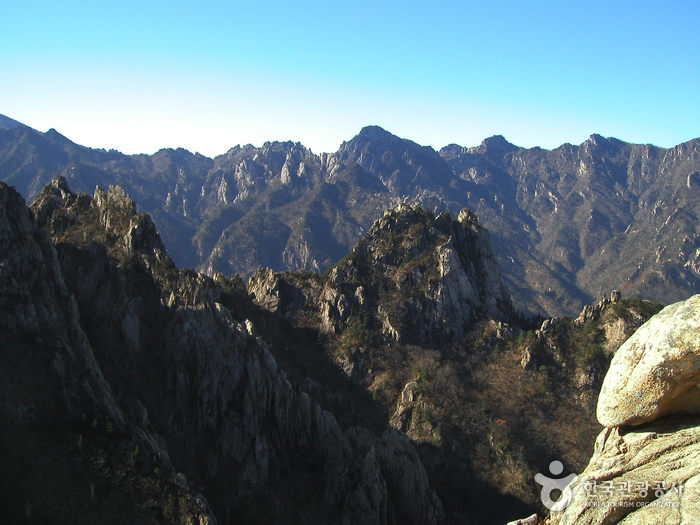
Seoraksan is the main mountain destination in this guide. The Korea National Park Service says it became Korea’s fifth national park in 1970, was designated a Natural Monument in 1965, and has been a UNESCO biosphere reserve since 1982. The park covers 400.027 km² across Inje, Goseong, Yangyang and Sokcho and has about 30 high peaks including Daecheongbong. The east side is called Oeseorak, the south Namseorak and the Inje side Naeseorak.
Gwongeumseong, a Goryeo-era stone fortress about 800 m above sea level on the Sokcho side, can be reached on foot or by cable car, and looks over the mountains and the East Sea, per KTO. The park service lists marked courses with distance, time and difficulty on its site; one example is a 3.2 km course from the Yaksuteo visitor support centre to Yongso Falls, listed as 1 hour and low difficulty.
- Getting there: the park’s traffic page gives driving directions only. Check the official page.
- Hours, closed days, admission: Check the official page for hours and admission. The park publishes trail restrictions: its notice list included an autumn trail access restriction notice dated 30 Oct 2026, and its page header showed partial trail control on 2 Nov 2026. Check these before choosing a hike.
- Official page · Map
Cheongchoho Lake (청초호)

A lagoon in the middle of Sokcho, about 5 km around, per the KTO record. A pavilion in the middle, Cheongchojeong, is reached by a 75 m bridge and has views toward Seoraksan. The shore has lit walking paths, and the record also mentions the Expo Tower (73.4 m) and a bird sanctuary nearby. It is a short stop in town rather than a full-day destination.
- Getting there: Check the official page for transport.
- Hours, closed days, admission: Check the official page for hours and admission.
- Map
Practical notes
- Trail and park closures. The Korea National Park Service posts partial trail closures for both Seoraksan and Odaesan in autumn, tied to the wildfire-caution period (Odaesan notice dated 2 Nov 2026, Seoraksan notice dated 30 Oct 2026). Both parks’ pages are in Korean; the Hangul words to look for are 탐방로 (trail) and 통제 (restricted).
- Ferry and opening times change. Nami Island lists extra sailings in some seasons and says hours can change. Ojukheon closes on 1 January, Seollal and Chuseok. See Korean Public Holidays 2026-2027.
- Weather. The east coast and the mountains can differ from Seoul. See Korea Weather by Season for what to pack.
- Language. Several official pages above are in Korean only. A browser translation tool is usually enough to read hours and fares, but confirm anything important with the venue.
Related guides
- Seoul Travel Guide: Major Sights and Access
- Suwon and Gyeonggi: Major Sights and Access
- Templestay in Korea: How to Book and What to Expect
Sources
- Korea National Park Service — Seoraksan National Park, checked 2 Nov 2026
- Korea National Park Service — Seoraksan traffic and courses, checked 2 Nov 2026
- Korea National Park Service — Seoraksan notices, checked 2 Nov 2026
- Korea National Park Service — Odaesan National Park, checked 2 Nov 2026
- Korail — Official Website for Foreigners, checked 2 Nov 2026
- Gangneung City — Transportation Information, checked 2 Nov 2026
- Gangneung City — Directions to Gangneung, checked 2 Nov 2026
- Visit Gangneung — transport information, checked 2 Nov 2026
- Gangneung tourism portal — Ojukheon, Gyeongpodae, Gyeongpo Beach and Jeongdongjin pages, checked 2 Nov 2026
- Nami Island — directions, ferry and fares pages, checked 2 Nov 2026
- Naksansa — home page, checked 2 Nov 2026
- Korea Tourism Organization — 100 Must-Visit Tourist Spots of Korea, checked 2 Nov 2026
- Korea Tourism Organization — Travel to Chuncheon in Gangwon-do by Subway, checked 2 Nov 2026
- Korea Tourism Organization — VISITKOREA place records (descriptions and coordinates), checked 2 Nov 2026